
Collaboration with Deschutes Brewery
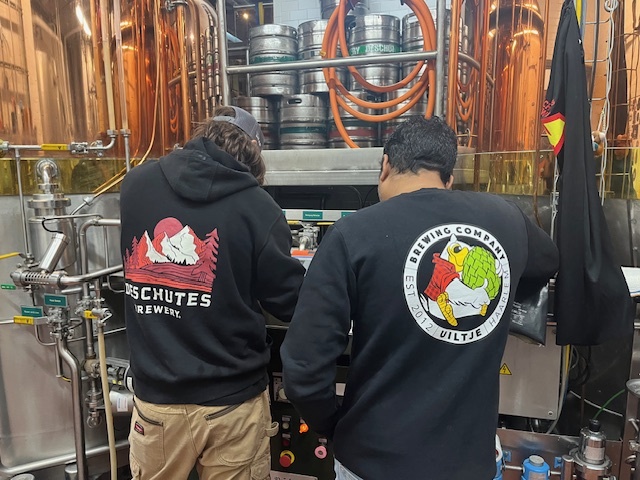
UILTJE Deschutes Brewery
INTERVIEW WITH JAKE HARPER, HEAD BREWER AT DESCHUTES BREWERY PORTLAND PUBLIC HOUSE
“It’s tough to stand out in Portland’s craft beer scene”
UILTJE: Jake, you’ve been with Deschutes Brewery for 25 years, and you’ve been the head brewer at this large pub in Portland for eight. How’s that going for you?
JH: Look around—I run my own pub, so I’d say I’m pretty happy.
UILTJE: I’m sure you’ve been asked every question under the sun. So what’s the one question no one ever asks you?
JH: Haha, that’s the question. Most people ask me, “What’s your favorite beer?” or “Which beer have you tweaked the most?” But I think what gets overlooked is how much you learn from brewing on different systems. Each one teaches you something new, and that knowledge really helps you fine-tune your process.
UILTJE: This pub has an incredible setup. What do you have, like 20 taps?
JH: 24, including a cask handle for an English Bitter.
UILTJE: What’s on tap now?
JH: We’re really focusing on lagers right now—we have about six or seven of them. It’s also fresh hop season, so we’ve got four fresh hop beers on tap, with two more on the way. We have a Japanese rice lager with honey, a Saison with honey, plus our other pub staples and core brands like Fresh Squeezed IPA, Black Butte Porter, King Crispy German Pilsner, and Fresh Haze.
UILTJE: How many mainstream brands does Deschutes carry?
JH: Our total portfolio is probably around 20, but our core brands number closer to seven or eight.
UILTJE: How many collaborations do you do here each year?
JH: About five to ten, including brewers and organizations focused on ingredients, such as the National Honey Board. I love working with hop growers, malt producers, and suppliers of unique ingredients.
UILTJE: Today we’re brewing a Helles Lager. That was a specific request from Paddi because it’s a style we’re eager to explore further in Haarlem.
JH: This is a Helles with a twist—we’re using a single hop, Dolcita. We’ve never brewed one like it. Our original idea was to make a fresh hop version, but we missed the harvest window by about a week. So Paddi suggested a Helles Lager, and I was all in. It’s tough to break out of the norm in Portland’s craft beer scene, so doing something fresh is always a win. We’ve used Dolcita in hazy IPAs and West Coast styles, but never in a lager, and never as a single-hop lager. I’ve tasted a few single-hop lagers with Dolcita and they’re phenomenal. I’m excited to see how this one turns out.
UILTJE: Do you get to travel a lot for collaborations, or do most of them happen here in Portland?
JH: Most brewers want to come here because of our system. Clay and I have the green light, but honestly, we rarely get to go out and sample beers at other breweries. We’ve done a few international collaborations, and I’d love to do more abroad—the Netherlands sounds like a great destination.
UILTJE: It’s lovely in the spring.
JH: Sounds great, let’s do it.
UILTJE: You’ve been at Deschutes for 25 years—is there still more to learn?
JH: Always. That’s the beauty of brewing. The science is constantly evolving, and there’s always something new to discover. For me, the biggest learning comes from exploring different brewing systems and seeing how they’re designed. I’ve brewed using 10 to 12 different kits, and each one has its own quirks.
UILTJE: How much creative freedom do you have to brew what you like?
JH: Total freedom—within budget constraints, of course. We’re essentially an R&D brewery here, so we get to experiment and let our creativity run wild. We’ve brewed everything from Bloody Mary and Margarita Sours to all kinds of offbeat styles. That’s the best part of the job: we’re not stuck churning out the same beers. We can test, tweak, and see what resonates with the public.
UILTJE: What’s your take on the current state of the craft beer market? An oversupply of hops, too many breweries?
JH: It’s a bit of both. There’s definitely a surplus of some raw materials because the industry has shrunk a bit. Younger generations are shifting toward flavored malt beverages, cider, and seltzers. Smaller breweries with niche portfolios—like all-Belgian or wild beers—are struggling to retain their customer base. We’ve adapted by exploring non-alcoholic options and tailoring our portfolio to younger drinkers by scaling back our core craft beer portfolio and making a big push into non-alcoholic beer—it’s a growing segment. We recently introduced Anytime Hard Lemonade to our portfolio and our pub guests loved it.
UILTJE: How about hop water? JH: Hop water is interesting, but I think it’s better suited for companies with strong analytical backing. A company like BarthHaas has the science to support iso extraction and hop oils. Craft breweries don’t have the same resources, and I don’t see a huge market for hop water in our space. If younger drinkers are moving away from craft beer, hops might be part of the reason. So replacing beer with hop-flavored water and no alcohol? I’m not sure what the appeal is.
UILTJE: Is the oversupply of hops affecting innovation?
JH: Possibly. There are a lot of new hop products—oils, extracts—and I wonder if that’s related to the surplus of leaf and pellet hops. These new formats offer brewers a higher yield than traditional T90 pellets, and growers might be able to produce more efficiently. We’ve continued to experiment with alternative hop products and have started using them in our production and development beers.
UILTJE: Deschutes has been around for 37 years. How do you balance tradition with innovation?
JH: Deschutes has done an excellent job of balancing tradition and innovation. A classic beer like Black Butte Porter, which we introduced back in 1988, is the #1 porter in the U.S. When we started investing in non-alcoholic beer a few years ago, we introduced Black Butte Non-Alcoholic. It’s now the fastest-selling non-alcoholic 6-pack in the country. Our Non-Alcoholic Fresh Squeezed IPA is also doing incredibly well.
UILTJE: And then you’re competing with breweries that have been acquired by larger companies and often have bigger marketing budgets.
JH: That’s true; we’re one of the largest independently owned breweries in the US. While our budgets are smaller than those of some publicly traded breweries, our focus remains on innovation.
UILTJE: Let’s talk about some of your bigger collaborations. You work with Patagonia and sell beer through Costco. How did those partnerships come about?
JH: We were grateful to be asked by Costco to produce some of their brands and are honored to have the Deschutes Brewery name featured on them. Patagonia Provisions wanted to expand their taproom program and find a brewing partner that shares their mission to brew bottled beer for nationwide distribution. We hold organic certification and believe in the mission of increasing the use of regenerative and organic ingredients within the industry. Today we have three USDA Certified Organic beers in partnership with them, two of which are non-alcoholic. Our Patagonia Provisions Non-Alcoholic Organic Golden won a gold medal at the 2024 GABF competition in the Specialty Non-Alcoholic Beer Category.
UILTJE: Was the Kirkland beer a new recipe or something you’d already developed?
JH: It originated from our lager program, which began with King Crispy—a German pilsner we brewed for a competition hosted by Bitburger and Prost. We won and were invited to Germany for a two-week collaboration. That beer kicked off our Crispy line: King Crispy, Ludwig Von Crispy, Contessa Crispy, and Prinz Crispy. Prinz Crispy won gold at The Great American Beer Festival three years ago, and that’s the beer that became the Kirkland Signature Helles Lager. We’ve stayed true to the original recipe and ingredients.
UILTJE: Where do you see the craft beer industry in five years?
JH: That’s a tough one. It really depends on younger beer drinkers and how many breweries can stay in business. We’ve seen exponential growth, then furloughs, and now—post-COVID—it feels like things are leveling off. The industry’s adaptability is what gives me hope.
UILTJE: And Deschutes specifically—what’s the five-year outlook?
JH: We are in a strong position for the next five years, with an exciting and diverse portfolio of liquid products.


Unfortunately, no access for you yet.
We look forward to seeing you again when you are 18!
Are you 18 years old or older?
Nothing personal, you just have to be 18 or older to visit our site. It's the law, sorry!