
Know your beer: The brewer story behind lost in thyme
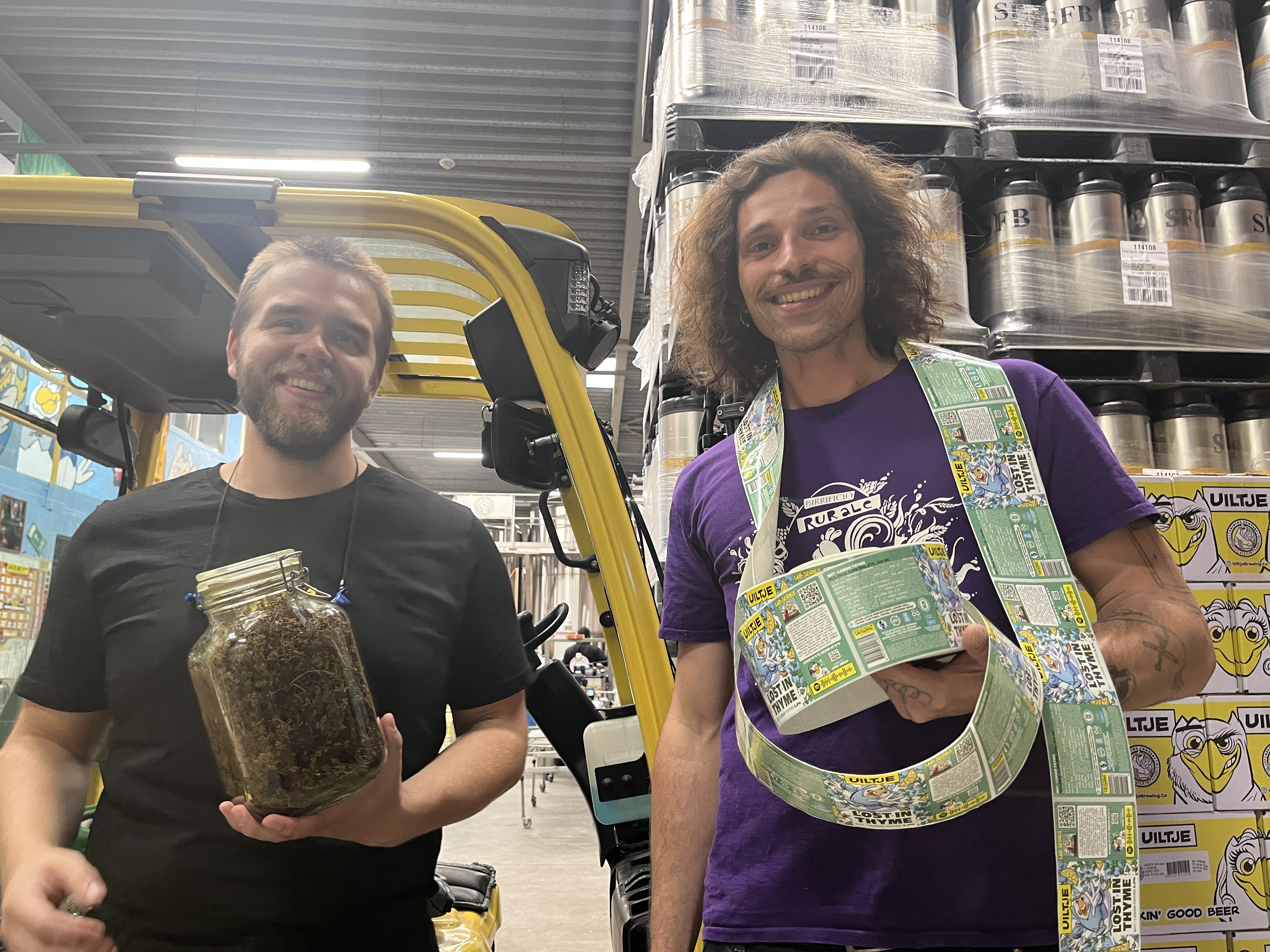
Last week Uiltje premiered Lost in Thyme at the Brewda Festival in Breda. This herbal twist to a Belgian Wit was an instant hit among brewers and casual beer drinkers alike. Who doesn’t like an easy-drinking classic? Behind the beer are Uiltje brewers Nicola and Sebastian. As with all Uiltje Lab Series beers, Nicola and Sebastian had the freedom to introduce their own signature and inject their own personalities into the beer. Yes, our Lab Series is personal. We sat down with both brewers to find out what makes Lost in Thyme a unique summer drink.
JOHN: Let’s start with the inception: how did this beer come about?
SEBASTIAN: Paddi [Uiltje head brewer] presented us with the style and ingredients but gave us the freedom to interpret it on our own. Nicola and I both made our own recipes and then compared notes. That was our starting point.
NICOLA: We worked back and forth and ended up with a recipe that combines lemon‑ish flowers and thyme. Those two flavors always work well together. It’s literally the best combination possible because it already exists in nature in lemon thyme.
SEBASTIAN: The challenge is combining lemon and thyme without either being too overpowering. Herbs can be very in‑your‑face if you add even a tiny bit too much. Our goal was to get subtle hints of thyme and lemon in there and it came out really good.
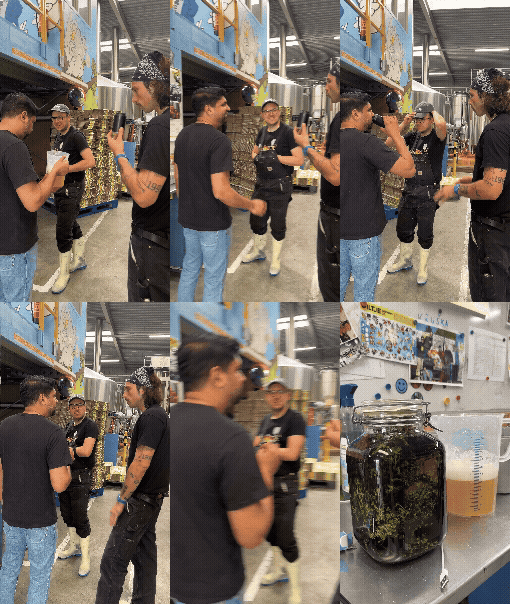
NICOLA: The flavors are our own creation. We fermented our own lemon juice and created our own thyme infusion by immersing loads of thyme in big jar full of alcohol. We did it all very slowly.
JOHN: Have either of you ever brewed a lemon thyme Wit before? Because the whole point of our Lab Series is to push you brewers out of your comfort zones, right?
SEBASTIAN: I’ve brewed a lot of witbiers with special additives before so know my way around them. But I’d never worked with thyme before. That was the nice thing about collaborating with Nicola. He knows a lot about the thyme; I know more about lemon.
NICOLA: To be honest, I’m an IPA guy. Wit is not usually my cup of tea. I don’t like a lot of lemon in my beer. But I do love thyme. So for me it was about finding the right balance between the two flavors. But as I said, these two ingredients work perfectly together and the result is very, very good. We premiered it at Brewda and it sold out immediately. Everyone we spoke to was really enthusiastic about it. So I’m proud.
JOHN:. I saw you guys experimenting with the thyme and the lemon in the brewery and there were long discussions between the brewers, especially about the amount of thyme.
NICOLA: It’s true, the original recipe had way more lemon and way less thyme. I didn’t want all that lemon, so we lowered the amount of lemon juice and added more thyme. Honestly, I expected we’d use a lot less thyme than we did. Then again, I also expected to use way more lemon juice than we ended up using. No one wants a Wit full of lemon; it doesn’t taste like a beer anymore.
JOHN: You didn’t want it to taste like a Radler.
NICOLA: Precisely!
JOHN: Did you use normal thyme or wild thyme?
SEBASTIAN: In the wild fermentation world, you see a lot of breweries using local herbs for special beers. And for witbiers you see this as well. But it remains a really a niche thing to do because when using wild herbs you have to make sure that there are no pesticides involved. There are a lot of health and safety regulations guiding our processes. I would love to just go out and pick some flowers and throw them in the kettle, but that’s just not the safe thing to do.
JOHN: What hops and yeast did you use?
SEBASTIAN: We used Saaz and Sorachi Ace, but I wouldn’t say that hops are really important in a witbier. It must be there for the backbone, but it’s not a priority. The yeast, however, is important. We used a wit yeast from WHC Lab, which works really well. As for the malt, we used a lot of wheat malt, some pilsner.
JOHN: Did you learn anything new during the brewing process?
NICOLA: I learned that thyme is very good in beer, which is surprising because so few brewers use it. I don’t know why.
We are using every herb and spice in the world, spices no one has ever heard of, yet there’s this beautiful herb in thyme that literally grows on my balcony in Amsterdam. I put it into my salads, my sauces, in soups, on meat, on potatoes. It’s just so aromatic.
JOHN: If it’s not clear to people reading this, you’re Italian. And like many Italians, you love great food. Everyone here at the brewery has benefited from your lunches. So just going to toss this out there: what would you pair Lost in Thyme with?
NICOLA: I have two great passions: beer and food. This recipe is a mix of the two. I think it works great with meat, because meat is super fatty in the mouth and this beer is a sort of palette cleanser. It’s a good barbecue beer.
JOHN: Now that you’ve used thyme, what are the chances you’ll use it again?
SEBASTIAN: We’re already brewing a session ale in white wine barrels with thyme. I think it’s going to work well.
Helaas, nog even geen toegang voor jou.
We zien je graag weer terug als je 18 bent!
Ben je 18 jaar of ouder?
Niks persoonlijks, je moet gewoon 18 jaar of ouder zijn om onze site te bezoeken. Het is de wet, sorry!